
Your Clients Know Legacy Is More Than Money. Do You?

A Total Family Perspective on What Families Really Value
Ask a room full of wealth advisors what legacy means, and you’ll likely hear answers centered around trusts, tax strategies, beneficiaries, and estate documents.
Ask a room of clients the same question — and you’ll hear something very different.
In a world of intergenerational planning, legacy is no longer just about assets. It’s about identity, purpose, relationships, and meaning. And as the next generation steps into leadership and inheritance roles, advisors who understand this shift will be the ones who earn deeper trust and longer relationships.
This blog explores the disconnect — and the opportunity — for advisors ready to engage clients on what legacy truly means.
What Clients Actually Value: The Five Forms of Family Capital
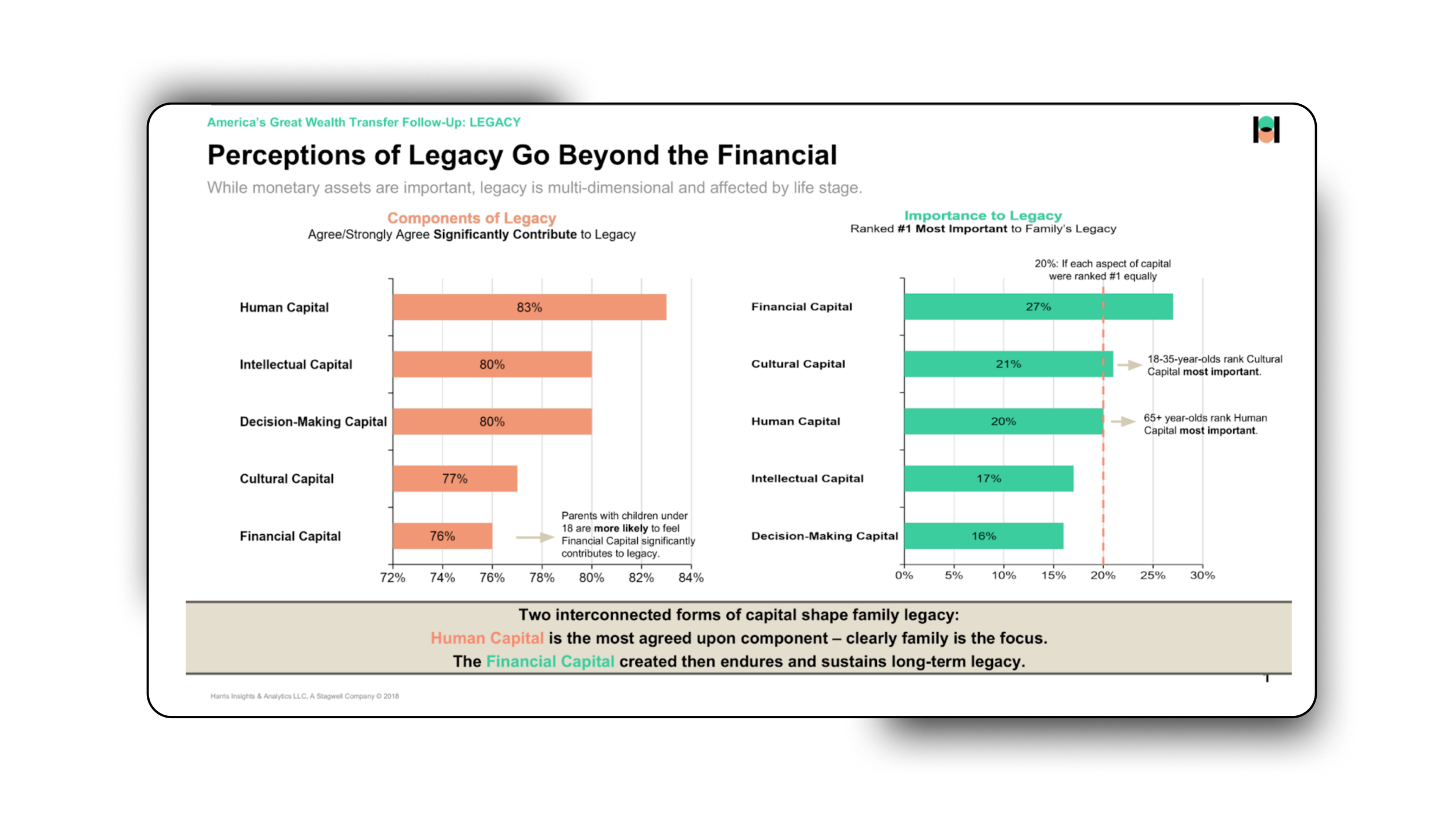
When Harris Insights and Analytics conducted the Great Wealth Transfer Survey (featured on the Visionary Advisor podcast), more than 2,000 participants ranked what they considered most important in their family legacy.
Here’s how the five forms of family capital ranked:
Human Capital (well-being, identity, growth)
Intellectual Capital (skills, knowledge, education)
Social Capital (relationships, networks, trust)
Cultural Capital (traditions, values, shared meaning)
Financial Capital (assets and wealth structures)
Yes — financial capital came in last.
Clients are telling us something clearly:
The money matters — but it is not the heart of legacy.
Legacy is about who their family becomes, not just what they own.
Why the Advisor-Client Gap Exists
This disconnect isn’t intentional. Most financial professionals default to financial capital because it’s:
Measurable
Familiar
Concrete
Advisors know how to analyze it. But clients — even ultra-wealthy ones — often lack the language to talk about the other forms of capital. So both sides end up focusing on what they can point to: money.
But that focus leaves out what matters most.
If financial capital is the least important form of legacy to clients, and it’s where we spend most of our time, we’re likely missing the conversation they want to have most.
Legacy Is Universal — and So Is the Opportunity
Legacy transcends wealth level.
You can’t talk to Taylor Swift or Michael Jordan about retirement readiness. But you can talk to them about legacy. The same goes for your clients — whether they’re billionaires, business owners, or early in their wealth journey.
Legacy speaks to:
Identity
Meaning
Continuity
And that always resonates.
Whether your clients are preparing the next generation, preserving family stories, or mapping out their vision, legacy planning creates space for the emotional and relational side of wealth — what we at Total Family call emotional wealth.
How Advisors Can Meet Clients Where They Are
Clients may not know how to ask for this work — but they know it matters.
That’s where Total Family and the FamilyOS platform come in. These tools don’t replace your financial planning — they enrich it by helping families engage with the qualitative side of wealth.
By giving clients structured space to:
Define their Values
Reflect on Milestones
Articulate a Shared Vision
...you help them activate four of the five forms of family capital. You’re no longer just managing a portfolio — you’re supporting family alignment, meaning, and legacy preservation.
And you're helping clients capture what no financial statement can show.
Legacy Is the Advisor’s Greatest Untapped Advantage
Advisors often ask: How do I stand out? How do I build deeper relationships?
Legacy conversations answer both.
Here’s what they unlock:
Stronger multi-generational trust
Clear differentiation in a crowded market
Loyalty that extends beyond the money
Alignment with what clients care about most
In a noisy, competitive wealth landscape, offering values-based planning and legacy tools creates connection that lasts.
So — Are You Meeting Them There?
Legacy conversations don’t require a dramatic shift. They start with curiosity.
They start with questions.
They start by naming legacy as something worth talking about.
You can begin by asking:
“What kind of impact do you want to leave?”
“What stories or values matter most to your family?”
“If we set money aside for a moment, what does legacy mean to you?”
The truth is, your clients are ready.
Many have been waiting for someone — anyone — to ask.
Where to Turn for Legacy Support
At Total Family, we support advisors who want to lead these conversations with confidence and clarity. Through FamilyOS, families gain tools to:
Write Legacy Letters
Preserve Milestones
Map out their Vision
Document emotional and cultural wealth
And ultimately build a family operating system they can revisit and evolve
These tools help you offer more — without having to do more.
The Bottom Line
Legacy isn’t a product. It’s not a planning phase. It’s not a tax strategy.
It’s a human need. It’s what clients are trying to express when they talk about purpose, impact, and preparing the next generation.
“In a world where you can search anything with AI,
there’s still no AI that can tell your children how proud you are —
or tell future generations your favorite movie.”
That’s what legacy is made of.
And your clients are ready to talk about it.
