
Where Do Advisors Turn for Help With Legacy?

Legacy work has become a meaningful part of how many wealth firms serve families. In most cases, it lives inside family office services and is developed internally over time.
The challenge is that much of this work is proprietary.
Thousands of firms are doing some form of legacy work, each in their own way. Ideas are rarely shared. Best practices are hard to capture. Language and frameworks vary widely.
As a result, many advisors end up starting from scratch.
They rely on instinct, experience, and trial and error. What works inside one firm stays there. What doesn’t work quietly disappears. Over time, family legacy planning across the industry becomes fragmented and inconsistent.
Information Isn’t the Problem
There is no shortage of legacy-related content online. Books, articles, videos, and frameworks are easy to find. Some are thoughtful. Others are shallow or disconnected from the realities of working with real families.
Finding what actually matters often feels like searching for a needle in a haystack.
Wealth advisors don’t need more volume. They need insight. They need tools shaped by experience — not theory. Typing legacy resources into Google isn’t enough. Clients can do that themselves.
Advisors need resources built specifically for them.
Legacy work touches Values, Purpose, family dynamics, and long-term decision-making. Advisors are expected to guide meaningful conversations about these topics, even though most material available wasn’t created with advisors in mind.
There’s a real gap between:
General legacy content written for families
Academic or theoretical frameworks
Practical guidance advisors can use in client meetings
That’s where many advisors get stuck.
They believe in the work. They see how it strengthens relationships and drives retention. But they don’t have a place to build fluency, deepen language, or get help in real time.
Why We Built Advisor Resources
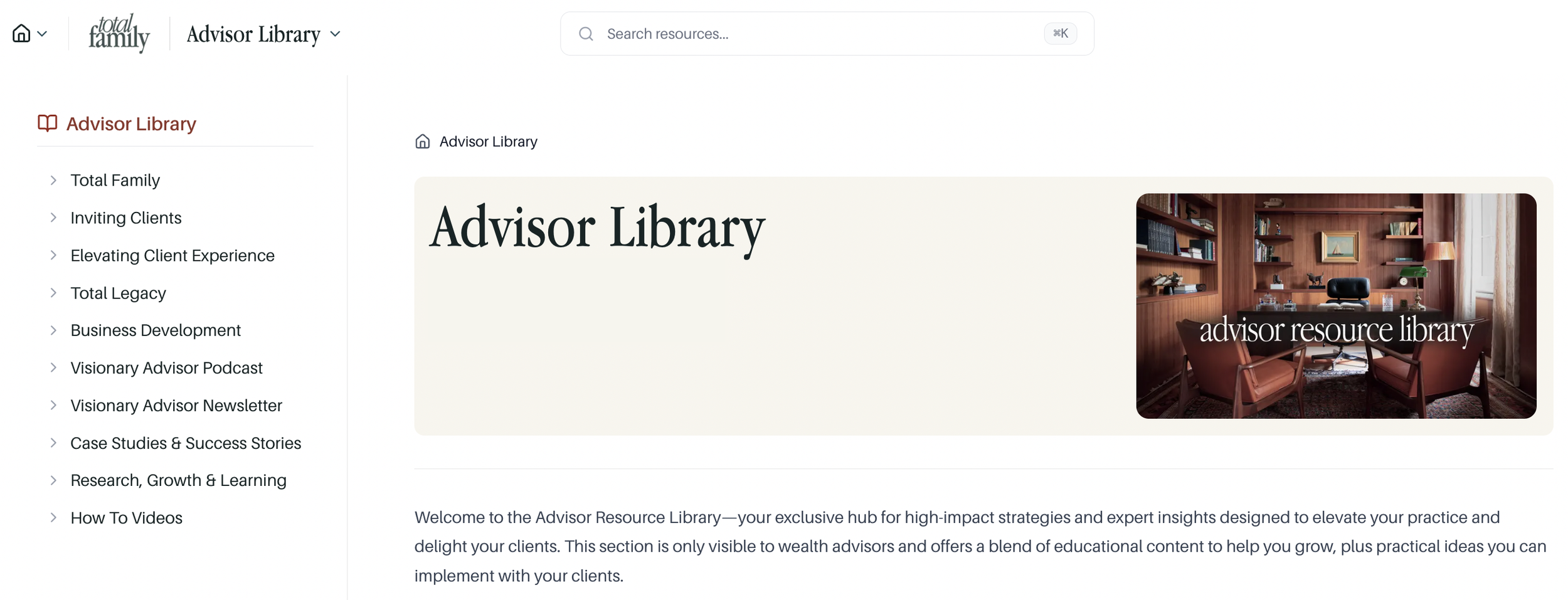
That gap is why we built the Advisor Resources library — a centralized, evolving home for the most practical ideas we’ve found.
Not everything that exists.
The most useful things.
It’s a curated environment for advisors who want to:
Understand core legacy concepts and shared language
Learn from respected voices in the field
Build consistency across client relationships
Apply ideas directly in planning conversations
Add continuity to their discovery and review process
What Advisors Are Saying
We’ve heard from dozens of advisors across RIAs, private banks, and family offices who say the same thing:
“Legacy work is part of how we serve families — but we’ve been building it from scratch.”
The Advisor Resources library gives them a place to test language, refine ideas, and revisit key concepts when client moments arise. It’s not another playbook to memorize. It’s a system you can return to — one that evolves as your practice grows.
A Companion Tool: Kin
Alongside the library, we created Kin, an AI tool designed to support legacy thinking. Advisors use Kin to:
Clarify what terms like Values and Purpose actually mean
Explore ideas like family transitions and multi-generational decision-making
Prepare for client conversations about vision, identity, and long-term goals
Kin doesn’t replace advisor judgment. It supports it.
Together, the resource library and Kin give advisors both structure and flexibility. One supports planning. The other supports learning and reflection. Both are built around the advisor’s real role — not an imagined one.
Why This Matters Now
As legacy work becomes a core part of multi-generational wealth planning, more advisors are being asked to show up confidently in conversations about identity, values, purpose, and continuity.
They’re not looking for inspiration.
They’re looking for practical tools that respect their time and sharpen their work.
That’s what we’re building:
A place where advisors can learn, test, and scale their legacy approach — so that legacy becomes a durable capability, not a one-off effort.
